Precalculus Honors · Study guide

5.1 · Circles and parabolas: completing the square and geometry

Translate equations into centers, radii, vertices, foci, and directrices, using completed squares rather than visual guesses.

Precalculus Honors · Reading: Demana 10th ed. §§8.1–8.2; Stewart 8th ed. §§1.9, 10.1, 10.4

Learning objectives

  • Identify a circle after completing the square.
  • Find a parabola’s focus and directrix.
  • Match a conic equation with its orientation.

Complete the square without changing the equation

A circle has form (x−h)2+(y−k)2=r2\displaystyle (x-h)^2+(y-k)^2=r^2, with center (h,k)\displaystyle (h,k) and radius r>0\displaystyle r>0. When completing squares, add the required amounts to both sides.

For x2+y2−4x+6y−12=0\displaystyle x^2+y^2-4x+6y-12=0, completion yields (x−2)2+(y+3)2=25\displaystyle (x-2)^2+(y+3)^2=25, revealing center (2,−3)\displaystyle (2,-3) and radius 5\displaystyle 5.

A parabola is an equal-distance locus

A point on a parabola is equally distant from its focus and directrix. In (x−h)2=4p(y−k)\displaystyle (x-h)^2=4p(y-k), the vertex is (h,k)\displaystyle (h,k), focus is (h,k+p)\displaystyle (h,k+p), and directrix is y=k−p\displaystyle y=k-p.

For (y−k)2=4p(x−h)\displaystyle (y-k)^2=4p(x-h), the opening is horizontal. The sign of p\displaystyle p determines up versus down or right versus left. The coefficient is 4p\displaystyle 4p, not p\displaystyle p itself.

(x−h)2=4p(y−k)(x-h)^2=4p(y-k)

Use a diagram to verify the features

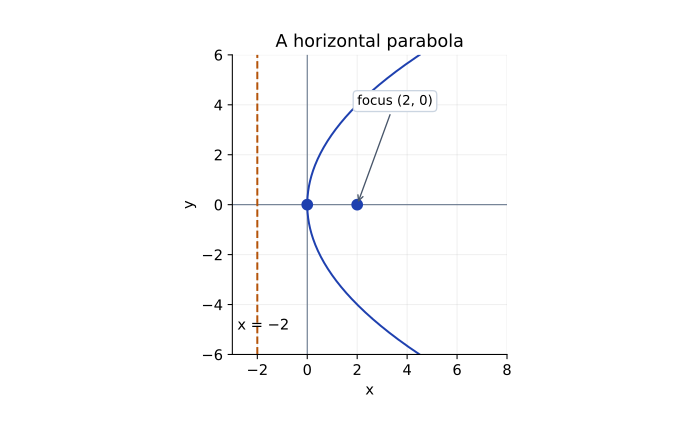
For y2=8x\displaystyle y^2=8x, the vertex is the origin, the focus is (2,0)\displaystyle (2,0), and directrix is x=−2\displaystyle x=-2. A horizontal axis of symmetry matches the horizontal displacement of the focus.

Check the original equation at a simple point and compare its distances to the focus and directrix. This confirms the geometry rather than just recalling a formula.

Worked examples

A circle

Find the center and radius of x2+y2−4x+6y−12=0\displaystyle x^2+y^2-4x+6y-12=0.

  1. Group x and y terms and move the constant.
  2. Add 4\displaystyle 4 and 9\displaystyle 9 to complete the two squares.
  3. The form is (x−2)2+(y+3)2=25\displaystyle (x-2)^2+(y+3)^2=25, so the center is (2,−3)\displaystyle (2,-3) and radius is 5\displaystyle 5.

A horizontal parabola

Find the focus and directrix of y2=8x\displaystyle y^2=8x.

  1. Match 4p=8\displaystyle 4p=8, giving p=2\displaystyle p=2.
  2. The vertex is (0,0)\displaystyle (0,0) and the focus is (2,0)\displaystyle (2,0).
  3. The directrix is x=−2\displaystyle x=-2.

Common mistakes

  • Reading the completed-square shifts with the wrong signs.
  • Using the coefficient 4p as the focal distance p.
  • Assigning a vertical focus to a horizontally opening parabola.

Try it yourself

No calculator required.

1. Find the vertex, focus, and directrix of y2=8x\displaystyle y^2=8x.

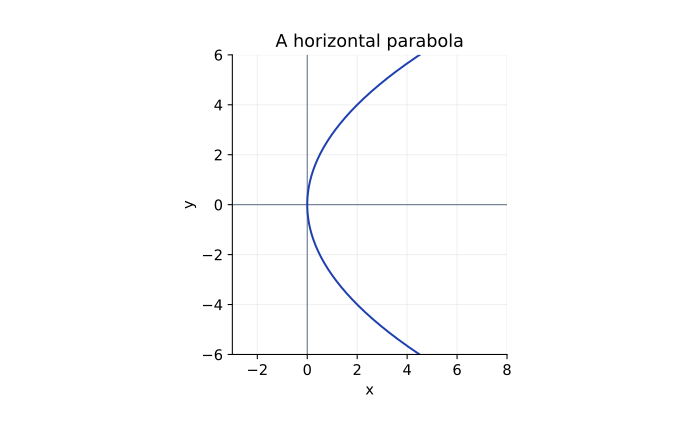
The curve y squared = 8x opens to the right.
Compare the equation with y squared = 4px.
Show worked solution

The coefficient gives p=2\displaystyle p=2. The vertex is (0,0)\displaystyle (0,0), the focus is (2,0)\displaystyle (2,0), and the directrix is x=−2\displaystyle x=-2.

The curve y squared = 8x opens to the right. The vertex is (0, 0), focus is (2, 0), and directrix is x = minus 2.
The vertex is (0, 0), focus is (2, 0), and directrix is x = minus 2.

2. Find the center and radius of x2+y2−4x+6y−12=0\displaystyle x^2+y^2-4x+6y-12=0.

Show worked solution

Completing the square gives (x−2)2+(y+3)2=25\displaystyle (x-2)^2+(y+3)^2=25. The center is (2,−3)\displaystyle (2,-3) and radius is 5\displaystyle 5.

3. For (x−1)2=−12(y+2)\displaystyle (x-1)^2=-12(y+2), find the vertex, focus, and opening direction.

Show worked solution

Here p=−3\displaystyle p=-3. The vertex is (1,−2)\displaystyle (1,-2), the focus is (1,−5)\displaystyle (1,-5), and the parabola opens downward. Its directrix is y=1\displaystyle y=1.

Need help with this topic?

Work through questions with a tutor and get help with the steps you find difficult.

Get help with this topic