
A polar conversion
Write in polar form.
- The modulus is .
- The point lies in Quadrant I with angle .
- Thus .
Precalculus Honors · Study guide
Use modulus and argument to organize complex multiplication, powers, and all roots without losing solutions.
Precalculus Honors · Reading: Demana 10th ed. §P.6, §6.6; Stewart 8th ed. §§1.6, 8.3
The number corresponds to point , with modulus . Choose an argument in the correct quadrant, then write .
Arguments differing by describe the same nonzero number. The argument of zero is not uniquely defined.
Polar multiplication follows the angle-addition formulas: multiply radii and add angles. Division divides moduli and subtracts arguments when the divisor is nonzero.
De Moivre’s Theorem gives for integers . Convert back to rectangular form when asked.
The nth roots of a nonzero number of modulus and argument have modulus and arguments for .
Listing only the principal argument gives one root instead of all of them. The roots are separated by angle , providing a geometric check on the list.
Write in polar form.
Evaluate .
No calculator required.
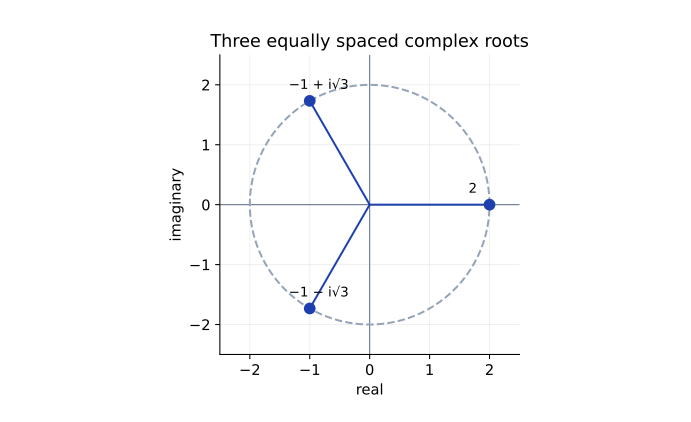
1. Find all three complex cube roots of .
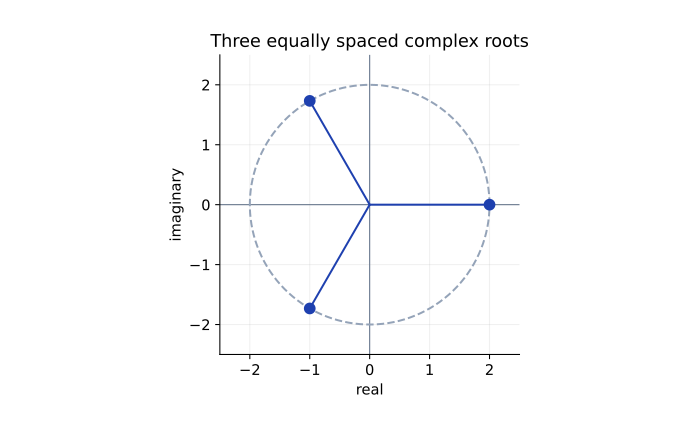
The root modulus is and arguments are . The roots are , , and .
2. Find the modulus and an argument of .
The modulus is . Quadrant II gives argument .
3. Evaluate .
The polar form has modulus and angle . Cubing gives modulus and angle , hence .
Work through questions with a tutor and get help with the steps you find difficult.
Get help with this topic