
Perpendicular vectors
Are and perpendicular?
- The dot product is .
- Both vectors have nonzero magnitude .
- They are perpendicular.
Precalculus Honors · Study guide
Connect components with magnitude and direction, use dot products for angles, and retain orientation when eliminating a parameter.
Precalculus Honors · Reading: Demana 10th ed. §§6.1–6.3; Stewart 8th ed. §§8.4–8.6
For a vector , magnitude is . Addition and scalar multiplication act on components. A unit vector in its direction is the original vector divided by its nonzero magnitude.
Two equal vectors can have different starting locations. A component diagram distinguishes a vector’s direction and length from the position of an endpoint.
For and , the dot product is . For nonzero vectors it also equals . A zero dot product therefore identifies perpendicular vectors.
The zero vector is orthogonal in the algebraic sense but has no defined direction angle. Check nonzero magnitudes before dividing to solve for an angle.
For , , eliminate using to obtain . The original parameter interval may describe only part of this parabola.
Elimination alone does not preserve orientation. Record how points move as increases, and translate any restrictions on into restrictions on the rectangular curve.
Are and perpendicular?
Eliminate for , , .
No calculator required.
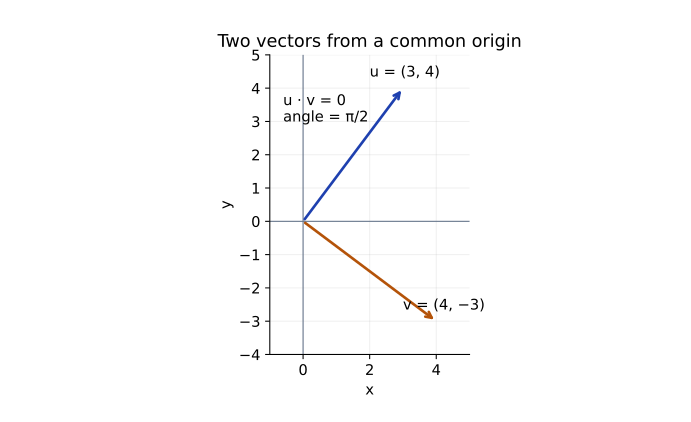
1. For and , find both magnitudes, the dot product, and the angle between them.
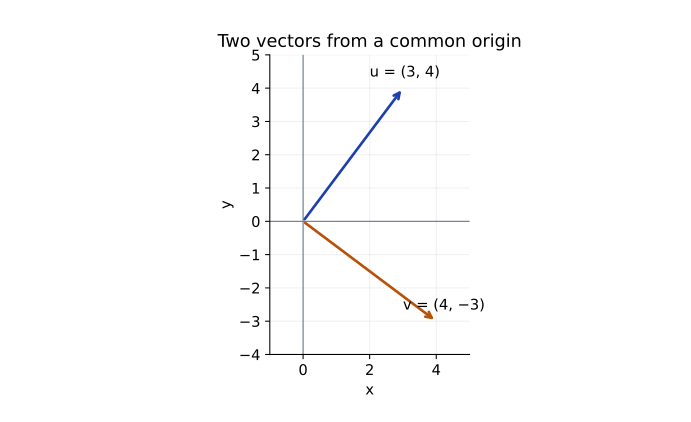
Both magnitudes are . The dot product is , so the angle is .
2. Find a unit vector in the direction of .
The magnitude is . Divide each component by it to obtain .
3. For , , , give a rectangular equation, restrictions, and direction.
The equation is on . It is traced from toward as increases.
Work through questions with a tutor and get help with the steps you find difficult.
Get help with this topic