
Convert a point
Convert to rectangular coordinates.
- Use .
- Use .
- The rectangular point is .
Precalculus Honors · Study guide
Convert between coordinate systems, interpret negative radii, and plot polar curves from their defining equations.
Precalculus Honors · Reading: Demana 10th ed. §§6.4–6.5; Stewart 8th ed. §§8.1–8.2
Polar coordinates locate a point by distance and direction. A negative radius plots in the direction opposite the specified angle. Equivalent representations include and .
The origin has many angle representations. When converting a nonzero rectangular point, use its quadrant rather than relying on a one-argument arctangent alone.
The identities are , , and . For a point , they give .
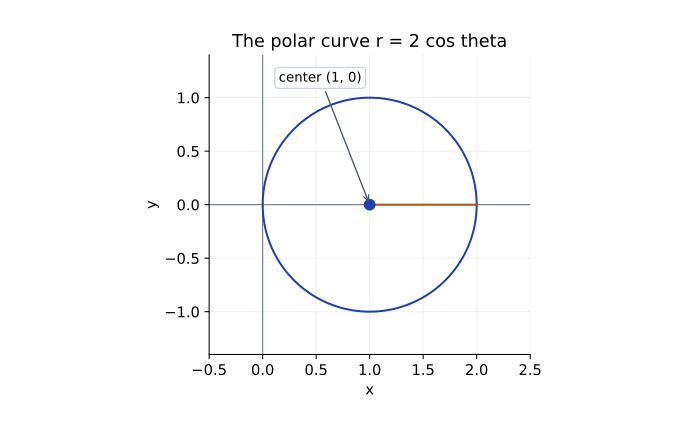
For , multiply by to obtain , hence . Completing the square identifies a circle centered at with radius .
Equations such as generate roses, but radius signs affect which direction each point lies. Evaluate several angles and inspect symmetry rather than treating as a rectangular height.
A zero radius marks the pole. A sketch should reflect the actual equation and interval; a curve may be traced multiple times as the angle runs through a full revolution.
Convert to rectangular coordinates.
Convert to a rectangular equation.
No calculator required.
1. Identify the curve and give its center and radius.
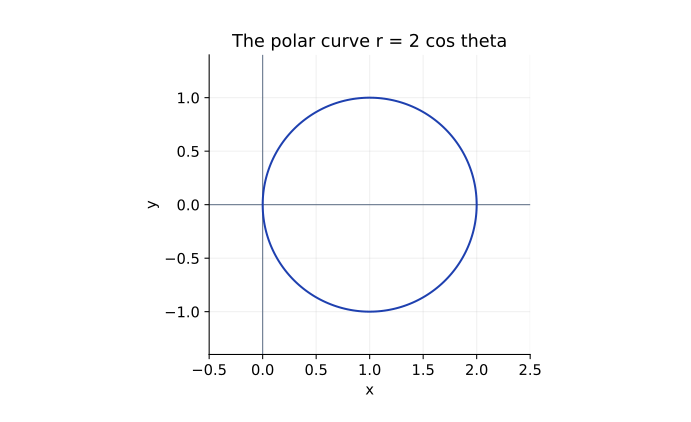
Conversion gives . It is a circle with center and radius .
2. Convert the polar point to rectangular coordinates.
The coordinates are .
3. Give a positive-radius representation of .
Reverse the direction by adding : represents the same point.
Work through questions with a tutor and get help with the steps you find difficult.
Get help with this topic