
An arithmetic term
Find the tenth term when and .
- Use .
- The value is .
- The offset is nine intervals from the first to the tenth term.
Precalculus Honors · Study guide
Distinguish constant differences from constant ratios, index sequences consistently, and test geometric-series convergence.
Precalculus Honors · Reading: Demana 10th ed. §§9.3–9.4; Stewart 8th ed. §§11.1–11.3
An arithmetic sequence has constant difference and formula . A geometric sequence has constant ratio and formula .
The indexing convention matters. If the starting value is labeled , the exponent or offset changes. Compare the formula at the stated first index before using it.
The finite arithmetic sum is . For a geometric sequence with , the sum is . If , simply add identical terms.
Summation notation specifies both a rule and an index interval. Count the included terms before applying a closed form; an upper index does not always equal the number of terms.
If , the geometric partial sums approach . If and the first term is nonzero, the infinite geometric series does not converge.
A sequence approaching zero is necessary for a series to converge but is not sufficient in general. The finite geometric formula remains valid even when an infinite sum is not.
Find the tenth term when and .
Find the sum .
No calculator required.
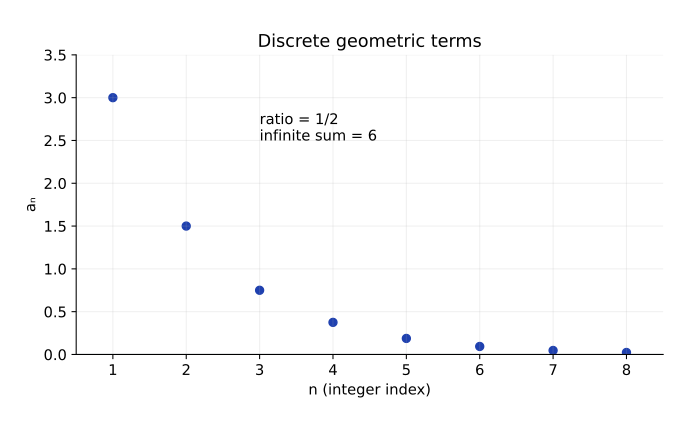
1. For the geometric sequence , give the first four terms and the infinite-series sum.
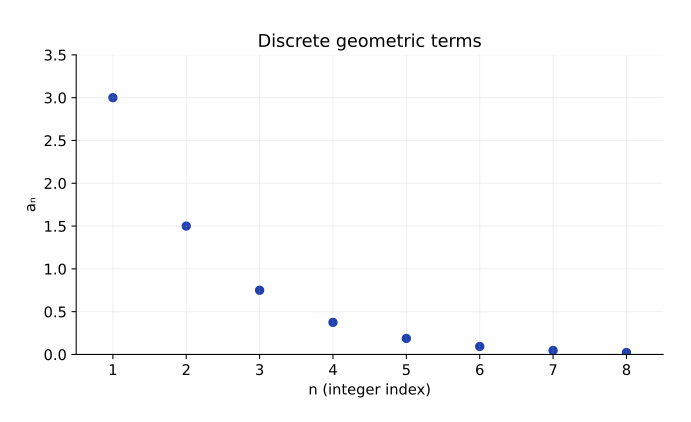
The terms are . Since , the infinite sum is .
2. Find the tenth term and the sum of the first ten terms for , .
The tenth term is . The sum is .
3. Does have a finite sum?
No. Its geometric ratio is , whose magnitude exceeds one. Its terms do not even approach zero, so the series diverges.
Work through questions with a tutor and get help with the steps you find difficult.
Get help with this topic