Precalculus Honors · Study guide

1.1 · Functions, domains, transformations, and inverses

Read a function through its formula, graph, and values; track domain restrictions through composition and inversion.

Precalculus Honors · Reading: Demana 10th ed. §§1.2–1.6; Stewart 8th ed. §§2.1–2.3, 2.6–2.8

Learning objectives

  • Find domains and interpret graph transformations.
  • Compute compositions with their restrictions.
  • Find an inverse and check its domain.

A function assigns one output to each allowed input

The domain contains the inputs for which the formula is defined. For a real square root, require a nonnegative radicand; for a denominator, exclude zero; for a logarithm, require a positive argument.

The graph’s vertical-line test checks whether every input has at most one output. A graph may represent a function while failing the horizontal-line test for an inverse function.

Transform the input and output separately

In g(x)=af(b(x−h))+k\displaystyle g(x)=a f(b(x-h))+k, the horizontal shift is h\displaystyle h, the vertical shift is k\displaystyle k, and nonzero a,b\displaystyle a,b control reflections and scaling. Horizontal distances scale by 1/∣b∣\displaystyle 1/|b|, while vertical distances scale by ∣a∣\displaystyle |a|.

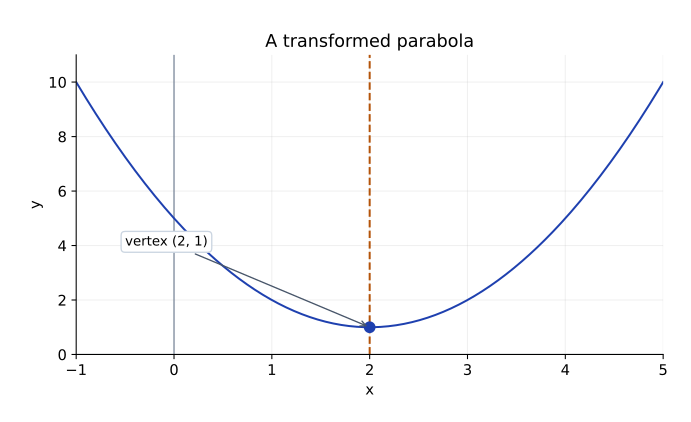
For g(x)=(x−2)2+1\displaystyle g(x)=(x-2)^2+1, the parent parabola moves right 2\displaystyle 2 and up 1\displaystyle 1. To read a composite horizontal transformation, factor the inner expression before identifying its shift.

g(x)=af(b(x−h))+kg(x)=a f(b(x-h))+k

Composition and inversion must preserve domains

The composition (f∘g)(x)=f(g(x))\displaystyle (f\circ g)(x)=f(g(x)) requires both an allowed input for g\displaystyle g and an output of g\displaystyle g that belongs to the domain of f\displaystyle f. Algebraic simplification does not restore excluded inputs.

To find an inverse, write y=f(x)\displaystyle y=f(x), interchange input and output, and solve. Restrict the original domain when needed for one-to-one behavior. The inverse domain is the original range.

Worked examples

A transformed parabola

Give vertex and range of g(x)=−2(x−3)2+4\displaystyle g(x)=-2(x-3)^2+4.

  1. The vertex is (3,4)\displaystyle (3,4).
  2. The negative leading coefficient makes the parabola open downward.
  3. The range is (−∞,4]\displaystyle (-\infty,4].

A linear inverse

Find the inverse of f(x)=3x−5\displaystyle f(x)=3x-5.

  1. Start with y=3x−5\displaystyle y=3x-5 and swap to x=3y−5\displaystyle x=3y-5.
  2. Solve to get y=(x+5)/3\displaystyle y=(x+5)/3.
  3. Thus f−1(x)=(x+5)/3\displaystyle f^{-1}(x)=(x+5)/3, and composition returns the input.

Common mistakes

  • Reading a horizontal shift with the wrong sign.
  • Ignoring restrictions after simplifying a composition.
  • Assuming a function is automatically one-to-one.

Try it yourself

No calculator required.

1. For g(x)=(x−2)2+1\displaystyle g(x)=(x-2)^2+1, identify the vertex, axis, domain, and range.
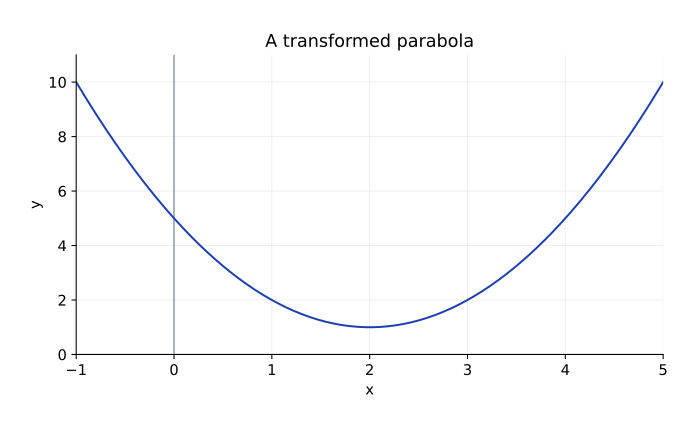
The graph of (x minus 2) squared plus 1 opens upward.
Read the shifted vertex and lowest output.
Show worked solution

The vertex is (2,1)\displaystyle (2,1) and axis is x=2\displaystyle x=2. The domain is all real numbers; the range is [1,∞)\displaystyle [1,\infty).

The graph of (x minus 2) squared plus 1 opens upward. The vertex is (2, 1), axis is x = 2, and range starts at 1.
The vertex is (2, 1), axis is x = 2, and range starts at 1.

2. Find the domain of x−1x−3\displaystyle \frac{\sqrt{x-1}}{x-3}.

Show worked solution

The radical requires x≥1\displaystyle x\geq1 and the denominator excludes 3\displaystyle 3. The domain is [1,3)∪(3,∞)\displaystyle [1,3)\cup(3,\infty).

3. If f(x)=x\displaystyle f(x)=\sqrt{x} and g(x)=x−2\displaystyle g(x)=x-2, find (f∘g)(x)\displaystyle (f\circ g)(x) and its domain.

Show worked solution

The composition is x−2\displaystyle \sqrt{x-2}, defined for x≥2\displaystyle x\geq2.

Need help with this topic?

Work through questions with a tutor and get help with the steps you find difficult.

Get help with this topic