
A hole and an asymptote
Analyze .
- The original domain excludes and .
- For allowed inputs, the formula simplifies to .
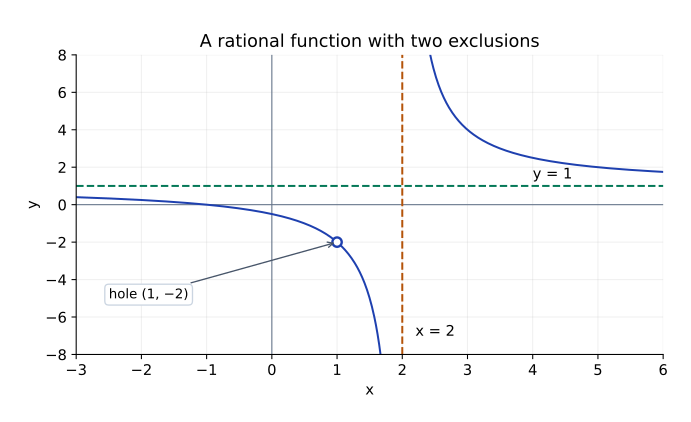
- There is a hole at and a vertical asymptote at ; the horizontal asymptote is .
Precalculus Honors · Study guide
Preserve exclusions, distinguish holes from asymptotes, and check proposed solutions after algebraic manipulation.
Precalculus Honors · Reading: Demana 10th ed. §§2.6–2.8; Stewart 8th ed. §§1.5–1.8, 3.6–3.7
A zero denominator gives an excluded input in the original formula. If its factor cancels fully, nearby behavior may have a finite limit, producing a hole. A remaining denominator factor can produce a vertical asymptote.
For , the graph agrees with away from , but the original function still excludes . Canceling changes the convenient formula, not the original domain.
For a proper rational function whose numerator degree is lower, the horizontal asymptote is . Equal degrees give the ratio of leading coefficients. Higher numerator degree requires division to describe the polynomial end behavior.
Asymptotes describe limiting behavior, not barriers that curves can never cross. A graph should also show intercepts, holes, and any restricted intervals.
Squaring a radical equation can introduce extraneous solutions. First isolate the radical, identify any sign restrictions, square, and substitute every candidate into the original equation.
Clearing denominators also requires the original excluded inputs to remain excluded. For inequalities, use a sign chart with both zeros and denominator exclusions; multiplying by an unknown-sign expression can reverse an inequality.
Analyze .
Solve .
No calculator required.
1. Classify the excluded inputs and asymptotes of .
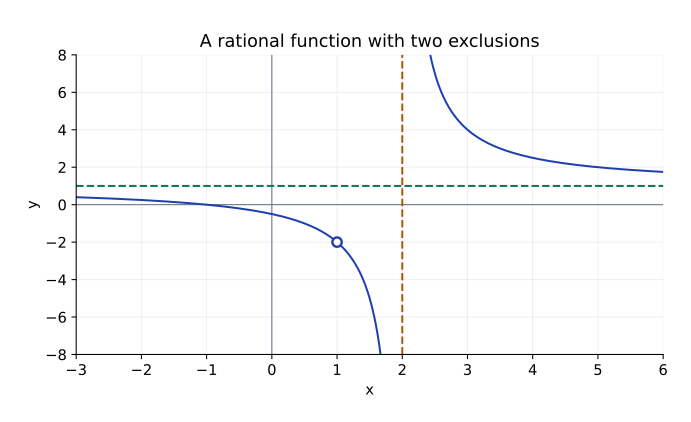
The exclusions are and . Canceling gives a hole at ; the remaining denominator gives as a vertical asymptote. Equal degrees give horizontal asymptote .
2. Solve and check every candidate.
Squaring gives . The candidate fails the nonnegative right-side requirement; works. The solution is .
3. Solve .
The critical inputs are and . A sign chart is positive on and . The denominator exclusion and strict inequality remove both endpoints.
Work through questions with a tutor and get help with the steps you find difficult.
Get help with this topic