
A logarithmic equation
Solve .
- The domain is .
- Combine the logs to obtain .
- The candidates are and ; only is allowed.
Precalculus Honors · Study guide
Use inverse relationships to solve equations, enforce logarithmic domains, and interpret growth rates and doubling times.
Precalculus Honors · Reading: Demana 10th ed. §§3.1–3.6; Stewart 8th ed. §§4.1–4.6
For , a unit increase in time multiplies the amount by . If there is growth; if there is decay. The base cannot be zero or negative for a real exponential defined on all real inputs.
The continuous model uses a continuous relative rate . A discrete increase of per period uses ; the corresponding continuous coefficient is , not necessarily .
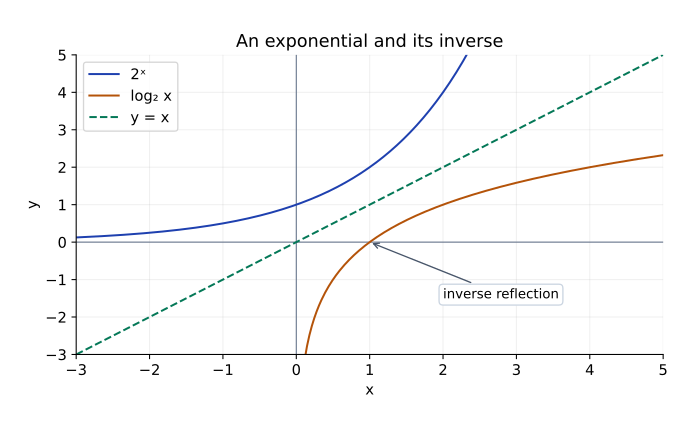
The statement is equivalent to , for , , and . Exponential and logarithmic graphs reflect across when their bases match.
The product, quotient, and power laws follow from exponent rules. They do not turn a logarithm of a sum into a sum of logarithms. In an equation, check every original log argument for positivity.
For doubling time , the continuous coefficient satisfies , so . For half-life , use . Retain exact logarithms until a decimal is required.
A logarithmic domain may remove an algebraic candidate. For , require before solving .
Solve .
An amount starts at and doubles every years. Find the amount after years.
No calculator required.
1. Compare and . State domains and their relationship.
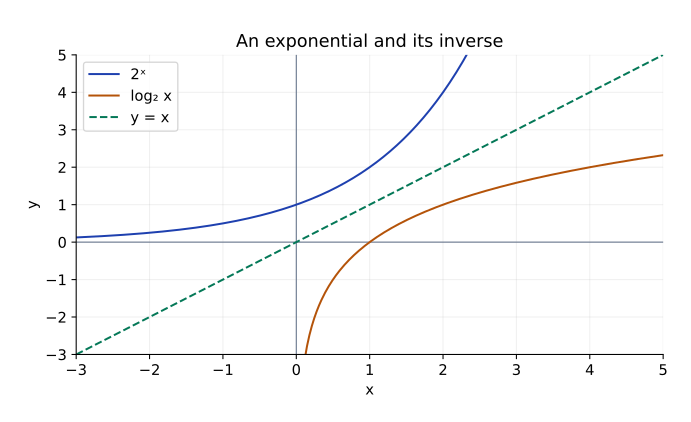
The exponential domain is all real numbers and its range is . The logarithm reverses these. They are inverse functions and their graphs reflect across .
2. Solve .
The original domain is . Combining logs gives , with candidates and . Only is valid.
3. An amount starts at and halves every years. Write its model and evaluate it at years.
The model is . At years, three half-lives give .
Work through questions with a tutor and get help with the steps you find difficult.
Get help with this topic