
Read a factored polynomial
Analyze the real zeros of .
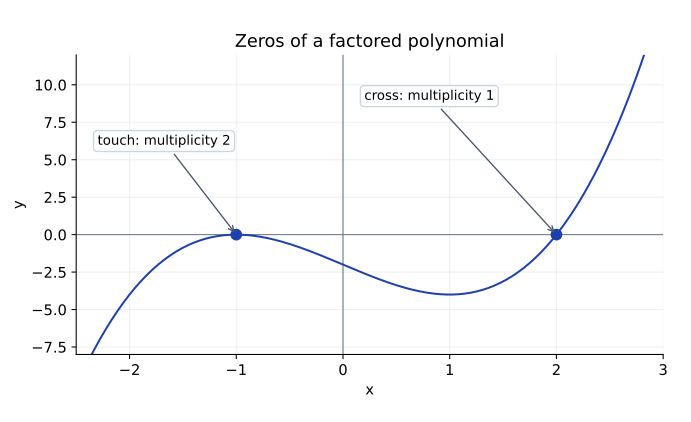
- The zeros are with multiplicity and with multiplicity .
- The graph touches at and crosses at .
- The positive cubic leading term makes the left end fall and the right end rise.
Precalculus Honors · Study guide
Connect factored form with intercepts, use multiplicity to predict crossings, and check polynomial factors algebraically.
Precalculus Honors · Reading: Demana 10th ed. §§2.1–2.5; Stewart 8th ed. §§3.1–3.5
For large , a polynomial behaves like its highest-degree term. An even degree with positive leading coefficient rises at both ends; an odd degree with positive leading coefficient falls to the left and rises to the right.
Factored form makes zeros visible, while expanded form makes degree and leading coefficient visible. Choose the form that answers the question rather than expanding automatically.
A factor gives zero with multiplicity . Odd multiplicity crosses the axis; even multiplicity touches and turns. Larger multiplicities flatten the curve near the intercept.
The degree counts complex zeros with multiplicity. For real coefficients, nonreal zeros occur in conjugate pairs. A graph shows real intercepts, not every complex zero.
The remainder from division by is . Thus is a factor exactly when . Synthetic division is a compact form of polynomial division by a linear factor.
The Rational Zero Theorem supplies candidates, not guaranteed roots. Substitute or divide to test candidates, then solve the lower-degree factor that remains.
Analyze the real zeros of .
Is a factor of ?
No calculator required.
1. For , identify zeros, multiplicities, end behavior, and the y-intercept.
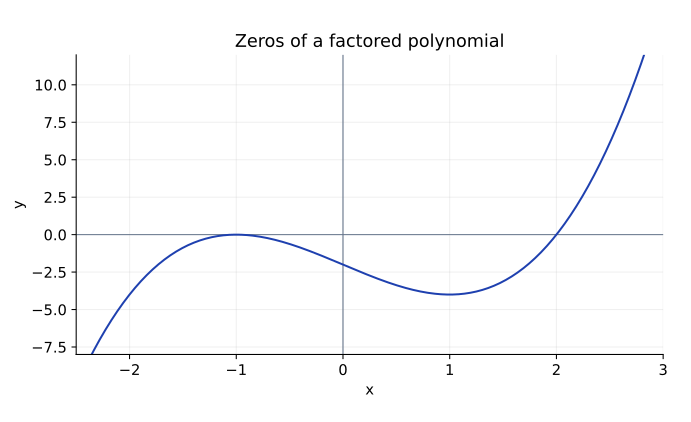
The graph touches at and crosses at . Its left end falls and right end rises. The y-intercept is .
2. Find the remainder when is divided by .
The remainder is .
3. A real-coefficient polynomial has zero . What other zero must it have?
The conjugate must also be a zero. The associated real quadratic factor is .
Work through questions with a tutor and get help with the steps you find difficult.
Get help with this topic