
Use SAS data
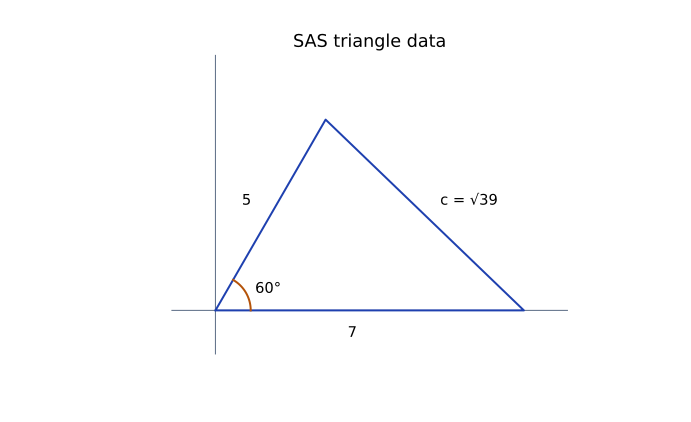
Two sides have lengths and with included angle . Find the third side.
- Use the Law of Cosines.
- The square is .
- The side length is .
Precalculus Honors · Study guide
Match the known triangle configuration to an efficient law, and check whether SSA data gives zero, one, or two triangles.
Precalculus Honors · Reading: Demana 10th ed. §§4.2, 4.8, 5.5–5.6; Stewart 8th ed. §§6.2, 6.5–6.6
Use lowercase opposite angles . In a right triangle, sine is opposite over hypotenuse and cosine is adjacent over hypotenuse. A diagram makes the reference angle explicit.
For nonright triangles, a known opposite side-angle pair suggests the Law of Sines. SSS or SAS data suggests the Law of Cosines.
The Law of Sines is . The Law of Cosines is . The included angle in SAS belongs between the two known sides.
Triangle area can be found by using two sides and their included angle. Keep enough precision in intermediate values if a decimal answer is required.
An inverse sine gives one angle, but its supplement may also fit. After finding , check whether is another candidate with a positive remaining angle.
If the computed sine exceeds , no triangle exists. If two candidates both satisfy the angle-sum condition, there are two triangles. Do not use SSA as a congruence rule.
Two sides have lengths and with included angle . Find the third side.
If , , and , find .
No calculator required.
1. Two sides are and with included angle . Find the third side and the area.
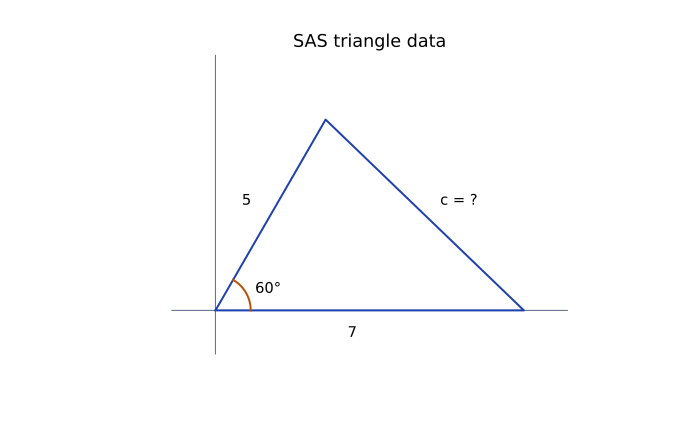
The third side is by the Law of Cosines. The area is .
2. If , , and , what are the possible values of angle ?
The Law of Sines gives . The candidates are and . Both leave a positive third angle because , so two triangles exist.
3. A right triangle has hypotenuse and angle . Find the opposite and adjacent legs.
The opposite leg is . The adjacent leg is .
Work through questions with a tutor and get help with the steps you find difficult.
Get help with this topic