
Eliminate a variable
Solve and .
- Add the equations to obtain .
- Thus and .
- Both original equations are satisfied.
Precalculus Honors · Study guide
Interpret solutions as intersections, use elimination efficiently, and distinguish inconsistent systems from dependent ones.
Precalculus Honors · Reading: Demana 10th ed. §§7.1, 7.3–7.4; Stewart 8th ed. §§9.1–9.2, 9.8–9.9
For two equations in and , a solution is an intersection of their graphs. Elimination combines equations to remove a variable; substitution replaces one variable using the other equation.
Always check a resulting pair in the original equations. A nonlinear system may have multiple intersections or none, even when an algebraic method initially produces several candidates.
If elimination produces a false statement such as , the system is inconsistent. If it produces an identity and no independent restriction remains, the lines coincide and there are infinitely many solutions.
For inequalities, the solution is an intersection of shaded regions. Boundary inclusion depends on whether each inequality is strict or inclusive.
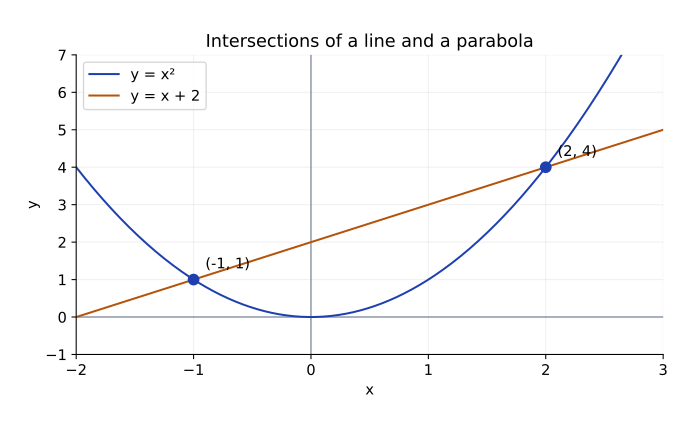
For and , equate the outputs to get . Each real root supplies a candidate intersection, and substitution gives its matching y-coordinate.
Graphs support interpretation, but exact substitution verifies the coordinates. A graphing window may hide an intersection far from the origin.
Solve and .
Find intersections of and .
No calculator required.
1. Find all intersections of and .
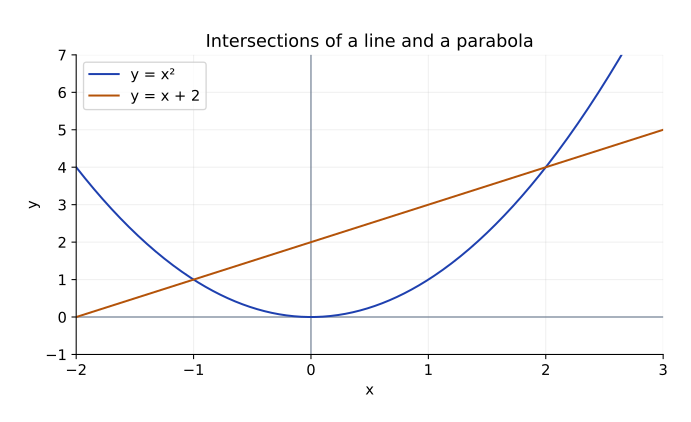
Equating gives . The intersections are and .
2. Solve and .
Add to obtain , so and .
3. Classify the system and .
Twice the first equation gives , contradicting the second. The parallel lines have no common point, so the system has no solution.
Work through questions with a tutor and get help with the steps you find difficult.
Get help with this topic