Precalculus Honors · Study guide

4.2 · Matrix operations, determinants, and linear systems

Track dimensions before computing, multiply rows by columns, and use determinants to test invertibility.

Precalculus Honors · Reading: Demana 10th ed. §§7.2–7.3; Stewart 8th ed. §§9.3–9.6

Learning objectives

  • Determine whether matrix operations are defined.
  • Compute a matrix-vector product.
  • Use a two-by-two determinant to test invertibility.

Dimensions come before arithmetic

An m\displaystyle m by n\displaystyle n matrix can multiply an n\displaystyle n by p\displaystyle p matrix, producing an m\displaystyle m by p\displaystyle p result. The inner dimensions must agree; the outer dimensions give the result size.

Addition requires matching dimensions. Matrix multiplication is generally not commutative: reversing the factors can change the result or make the product undefined.

A product entry is a row-column dot product

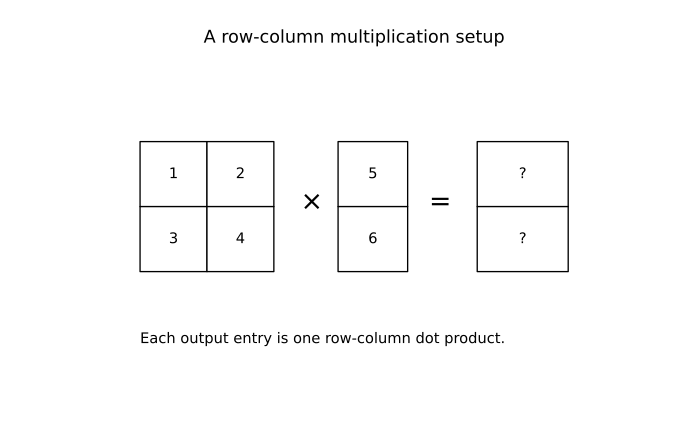
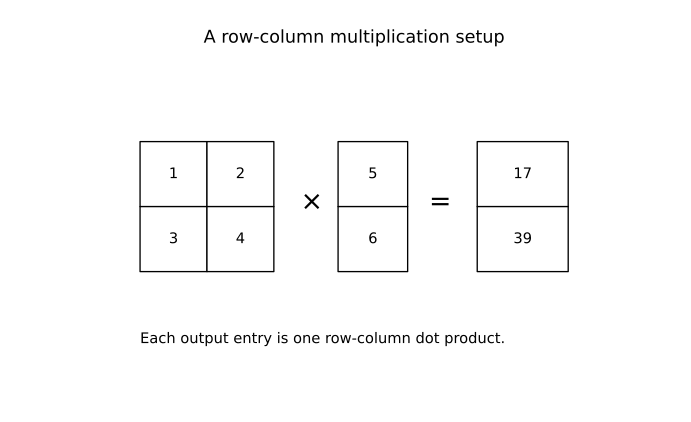
For a matrix with rows (1,2)\displaystyle (1,2) and (3,4)\displaystyle (3,4) multiplying a column with entries 5,6\displaystyle 5,6, the output entries are 1(5)+2(6)=17\displaystyle 1(5)+2(6)=17 and 3(5)+4(6)=39\displaystyle 3(5)+4(6)=39.

Writing a row beside its matching column helps avoid multiplying corresponding entries without summing. Matrix-vector multiplication packages a linear system’s left sides.

The determinant detects invertibility

For a two-by-two matrix with rows (a,b)\displaystyle (a,b) and (c,d)\displaystyle (c,d), the determinant is ad−bc\displaystyle ad-bc. A nonzero determinant gives an inverse and a unique solution for every right-hand vector.

A zero determinant means the coefficient matrix is singular. The associated system can be inconsistent or dependent, so the determinant alone does not distinguish no solution from infinitely many.

det⁡A=ad−bc\det A=ad-bc

Worked examples

Multiply by a column

A matrix has rows (1,2)\displaystyle (1,2) and (3,4)\displaystyle (3,4). Multiply it by the column (5,6)\displaystyle (5,6).

  1. The first row gives 1(5)+2(6)=17\displaystyle 1(5)+2(6)=17.
  2. The second gives 3(5)+4(6)=39\displaystyle 3(5)+4(6)=39.
  3. The product column has entries 17,39\displaystyle 17,39.

Test invertibility

A matrix has rows (2,1)\displaystyle (2,1) and (3,4)\displaystyle (3,4). Is it invertible?

  1. The determinant is 2(4)−1(3)\displaystyle 2(4)-1(3).
  2. Its value is 5\displaystyle 5, which is nonzero.
  3. The matrix is invertible.

Common mistakes

  • Multiplying entries without summing row-column products.
  • Assuming AB equals BA.
  • Concluding a singular system must have exactly one particular kind of failure.

Try it yourself

No calculator required.

1. A matrix has rows (1,2)\displaystyle (1,2) and (3,4)\displaystyle (3,4). Multiply it by a column with entries 5,6\displaystyle 5,6.

A two by two matrix with rows (1, 2) and (3, 4) multiplies a column (5, 6).
Multiply each row by the column and add its products.
Show worked solution

Row-column dot products give 17\displaystyle 17 and 39\displaystyle 39. The product is a two-entry column.

A two by two matrix with rows (1, 2) and (3, 4) multiplies a column (5, 6). The output entries are 17 and 39.
The output entries are 17 and 39.

2. If A\displaystyle A is 2\displaystyle 2 by 3\displaystyle 3 and B\displaystyle B is 3\displaystyle 3 by 4\displaystyle 4, state the dimensions of AB\displaystyle AB. Is BA\displaystyle BA defined?

Show worked solution

The product AB\displaystyle AB is 2\displaystyle 2 by 4\displaystyle 4. The reversed product is not defined because its inner dimensions would be 4\displaystyle 4 and 2\displaystyle 2.

3. Find the determinant of the matrix with rows (2,1)\displaystyle (2,1) and (3,4)\displaystyle (3,4) and state what it implies.

Show worked solution

The determinant is 8−3=5\displaystyle 8-3=5. The matrix is invertible, so its coefficient system has a unique solution for every right-hand vector.

Need help with this topic?

Work through questions with a tutor and get help with the steps you find difficult.

Get help with this topic