Precalculus Honors · Study guide

2.3 · Trigonometric identities and equations

Choose identities from expression structure, retain domain restrictions, and list every solution in the requested interval.

Precalculus Honors · Reading: Demana 10th ed. §§5.1–5.4; Stewart 8th ed. §§7.1–7.5

Learning objectives

  • Simplify with Pythagorean and angle formulas.
  • Verify identities without assuming the conclusion.
  • Solve trigonometric equations over a stated interval.

An identity is true on a common domain

The Pythagorean identity sin⁡2x+cos⁡2x=1\displaystyle \sin^2x+\cos^2x=1 supports many rewrites. For (1−cos⁡2x)/sin⁡x\displaystyle (1-\cos^2x)/\sin x, replace the numerator by sin⁡2x\displaystyle \sin^2x, then cancel only where the original denominator is nonzero.

To verify an identity, transform one side or transform both toward an independent expression. Domain exclusions remain in force after cancellation.

Addition and double-angle formulas create exact values

The formulas sin⁡(a+b)=sin⁡acos⁡b+cos⁡asin⁡b\displaystyle \sin(a+b)=\sin a\cos b+\cos a\sin b and cos⁡(a+b)=cos⁡acos⁡b−sin⁡asin⁡b\displaystyle \cos(a+b)=\cos a\cos b-\sin a\sin b let you evaluate angles built from known ones.

The double-angle identities include sin⁡2x=2sin⁡xcos⁡x\displaystyle \sin2x=2\sin x\cos x and cos⁡2x=1−2sin⁡2x=2cos⁡2x−1\displaystyle \cos2x=1-2\sin^2x=2\cos^2x-1. Select a form matching the equation you need to solve.

Find all angles, not just the inverse output

For 2sin⁡x=1\displaystyle 2\sin x=1 on [0,2π)\displaystyle [0,2\pi), the principal reference angle is π/6\displaystyle \pi/6 but Quadrants I and II both have positive sine. The solutions are π/6\displaystyle \pi/6 and 5π/6\displaystyle 5\pi/6.

Factoring a trigonometric equation is often safer than dividing by a trig factor, which can discard zero-factor solutions. Check endpoints against whether the interval is closed or half-open.

Worked examples

Simplify with a restriction

Simplify (1−cos⁡2x)/sin⁡x\displaystyle (1-\cos^2x)/\sin x.

  1. The numerator becomes sin⁡2x\displaystyle \sin^2x.
  2. For sin⁡x≠0\displaystyle \sin x\ne0, cancellation leaves sin⁡x\displaystyle \sin x.
  3. The original excluded inputs remain excluded.

A double-angle equation

Solve cos⁡2x=0\displaystyle \cos2x=0 on [0,2π)\displaystyle [0,2\pi).

  1. The angle 2x\displaystyle 2x runs over [0,4π)\displaystyle [0,4\pi).
  2. Its solutions are π/2,3π/2,5π/2,7π/2\displaystyle \pi/2,3\pi/2,5\pi/2,7\pi/2.
  3. Dividing by 2\displaystyle 2 gives π/4,3π/4,5π/4,7π/4\displaystyle \pi/4,3\pi/4,5\pi/4,7\pi/4.

Common mistakes

  • Dividing by a trig factor that could be zero.
  • Reporting only the inverse-function output.
  • Dropping an original denominator restriction.

Try it yourself

No calculator required.

1. Solve 2sin⁡x=1\displaystyle 2\sin x=1 on [0,2π)\displaystyle [0,2\pi).

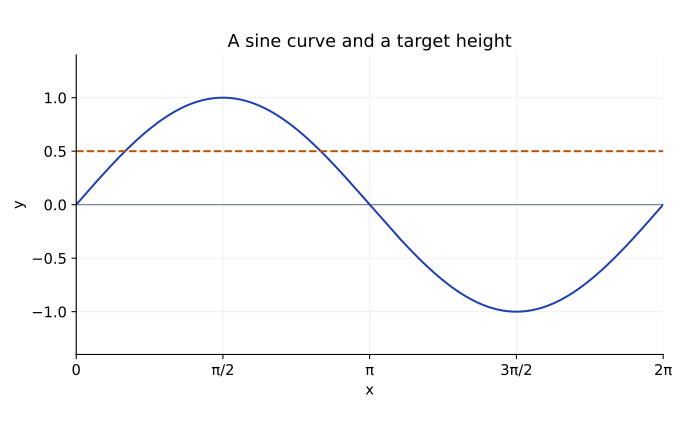
The sine graph intersects the horizontal level one half twice on [0, 2 pi).
Find both intersections in the stated interval.
Show worked solution

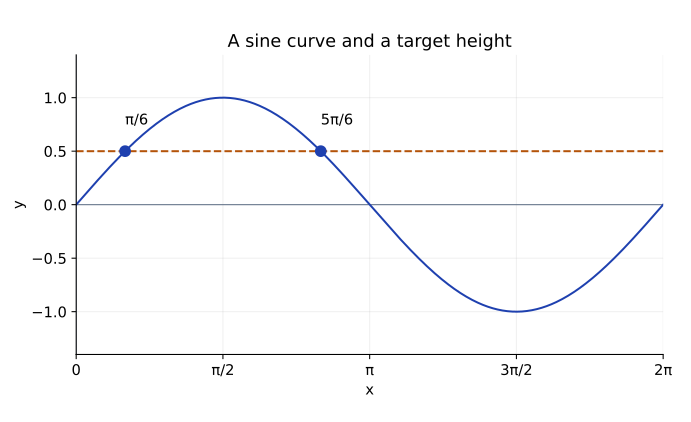
The horizontal level 1/2\displaystyle 1/2 meets sine in Quadrants I and II: x=π/6\displaystyle x=\pi/6 and x=5π/6\displaystyle x=5\pi/6.

The sine graph intersects the horizontal level one half twice on [0, 2 pi). The intersections occur at pi over 6 and 5 pi over 6.
The intersections occur at pi over 6 and 5 pi over 6.

2. Find cos⁡(π/4+π/6)\displaystyle \cos(\pi/4+\pi/6) exactly.

Show worked solution

Use the addition formula to get (2/2)(3/2)−(2/2)(1/2)=(6−2)/4\displaystyle (\sqrt{2}/2)(\sqrt{3}/2)-(\sqrt{2}/2)(1/2)=(\sqrt{6}-\sqrt{2})/4.

3. Solve sin⁡xcos⁡x=0\displaystyle \sin x\cos x=0 on [0,2π)\displaystyle [0,2\pi).

Show worked solution

One factor must be zero. The solutions are 0,π/2,π,3π/2\displaystyle 0,\pi/2,\pi,3\pi/2. Dividing by either factor would lose some solutions.

Need help with this topic?

Work through questions with a tutor and get help with the steps you find difficult.

Get help with this topic