
Quadrant II values
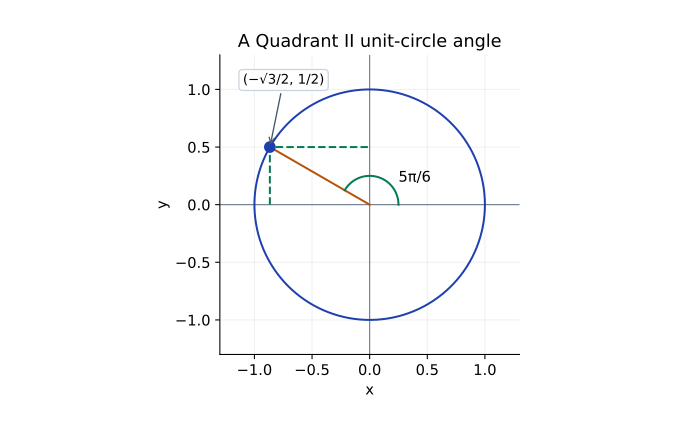
Find sine and cosine at .
- The reference angle is .
- The point is in Quadrant II.
- Thus sine is and cosine is .
Precalculus Honors · Study guide
Read sine and cosine as coordinates, use reference angles, and connect radian measure to arc length.
Precalculus Honors · Reading: Demana 10th ed. §§4.1–4.3; Stewart 8th ed. §§5.1–5.2, 6.1–6.3
An angle in radians satisfies , so an arc has length . A full revolution is radians or . Convert degrees by multiplying by .
The formula requires radians. A radian is a dimensionless ratio, so arc length has the same units as the radius.
On the unit circle, the point at angle is . Tangent is the ratio where cosine is nonzero. The reciprocal functions require their corresponding denominators to be nonzero.
Special triangles give the values for , , and . Use the reference angle for magnitudes, then the quadrant for signs; do not memorize every signed value independently.
Adding for an integer leaves the unit-circle point unchanged. A reference angle is the acute angle between the terminal side and the horizontal axis.
At , the reference angle is in Quadrant II, so cosine is negative and sine is positive. Reciprocal functions inherit the signs of their denominators.
Find sine and cosine at .
Find the arc length for radius and central angle .
No calculator required.
1. Find , , and .
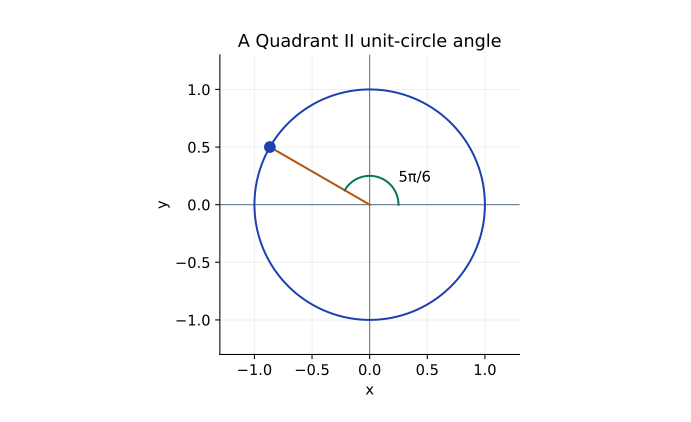
The reference angle is in Quadrant II. The values are , , and , respectively.
2. Convert to radians and identify the quadrant.
The radian measure is , in Quadrant III.
3. A circle has radius cm and central angle . Find its arc length.
Use to obtain centimeters.
Work through questions with a tutor and get help with the steps you find difficult.
Get help with this topic