
A shifted squeeze
For near , suppose . Find .
- The inequality holds near the target input .
- As , .
- Both outer functions approach .
- By the Squeeze Theorem, , regardless of .
Calculus Honors · AP-aligned study guide
Trap a difficult function between simpler bounds, evaluate foundational trigonometric limits, and connect formulas with graphical and numerical evidence.
AP topics 1.8–1.9; trigonometric limit applications of 1.6 · Reading: Larson & Edwards §1.3
Suppose for all x sufficiently close to a, except possibly at a itself. If both outer functions approach the same finite value L as x approaches a, the middle function must also approach L. This is the Squeeze Theorem. You do not need to know f(a).
All three conditions matter: the inequality must hold throughout a deleted neighborhood, both bounding limits must exist, and those limits must agree. Bounds approaching different numbers do not determine a unique limit.
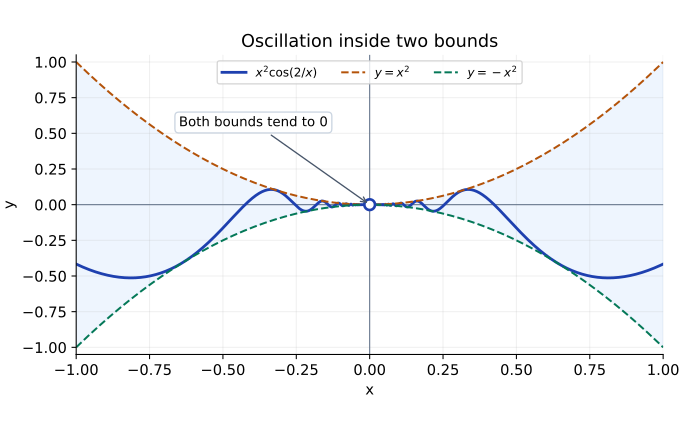
The function oscillates endlessly as x approaches 0 and has no limit there. However, . Multiplying by the nonnegative number x² gives . Both bounds approach 0, so the product approaches 0.
Graphically, the oscillating curve stays inside the envelope . The oscillations never stop, but their height shrinks. Do not assume that a product has no limit just because one factor has no limit.
Measure angles in radians. For , a unit-circle comparison of a triangle, a sector, and a tangent triangle gives . Dividing and rearranging gives . Since approaches 1, the Squeeze Theorem gives a right-hand limit of 1.
Because , the ratio is even. The left-hand limit is also 1, so the two-sided limit is 1. The radians condition is essential: the sector-area comparison uses radian measure.
To evaluate near 0, rewrite it as . The inner input 5x approaches 0, so the standard ratio approaches 1 and the result is . The argument inside sine must match the denominator in the standard ratio.
For , multiply by to obtain . The first factor approaches 1 and the second approaches 0. Their product approaches 0. These arguments use algebra and known limits, so derivative-based rules are unnecessary.
A plot or a table can suggest a limit and help you choose a method, but finitely many samples cannot establish behavior at every nearby input. For an oscillating function, a graph can also hide rapid oscillations when its resolution is too coarse.
Translate a bound into a graphical envelope, identify what happens to the envelope, then write the matching analytic limits. For AP-style justification, state the inequality, evaluate both outer limits, name the Squeeze Theorem, and give the resulting limit.
For near , suppose . Find .
Evaluate in radians.
No calculator required.
1. Suppose near . Find and name the theorem.
Both bounding functions approach : . Since the inequalities hold near , the Squeeze Theorem gives .
2. Evaluate . Justify your answer with bounds.
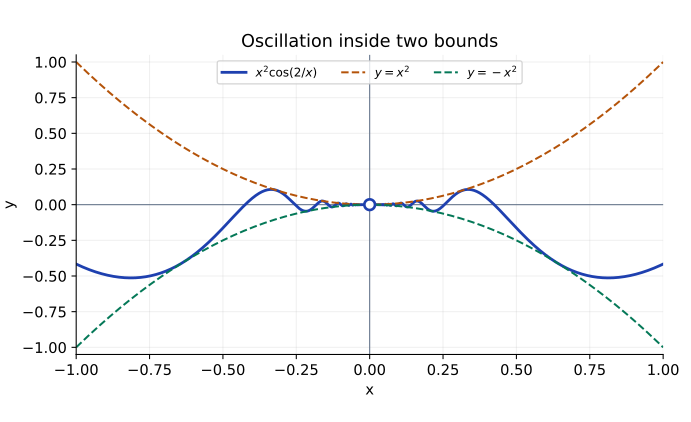
Since and , we have . Both bounds approach . The Squeeze Theorem gives , even though the cosine factor oscillates.
3. Evaluate in radians. Rewrite it using the standard trigonometric limit.
Rewrite as . As , the ratio approaches . The limit is .
4. You know only that near . Must exist? Give a counterexample.
No: the two bounds have different limits. The function stays between them but has no limit at . There are sequences of inputs tending to for which the outputs stay at , and others for which they stay at .
Work through questions with a tutor and get help with the steps you find difficult.
Get help with this topic