1.1 · Understanding limits: graphs, tables, and one-sided behavior
Describe what a function approaches, distinguish a limit from a function value, and connect graphical and numerical evidence.
AP topics 1.1–1.4 and 1.9 · Reading: Larson & Edwards §§1.1–1.2; one-sided limit ideas from §1.4
Learning objectives
Read limit notation and distinguish approach from evaluation.
Estimate limits using values on both sides of a point.
Use matching one-sided limits to decide whether a two-sided limit exists.
Why calculus begins with approach
Average velocity measures change over a time interval. Instantaneous velocity asks what those averages approach as the interval shrinks toward zero. We cannot divide by an interval of zero; instead, we study a limit. The same idea turns secant slopes into tangent slopes in the next unit.
The statement x→alimf(x)=L says that f(x) can be made as close as desired to L by choosing x sufficiently close to a, with x=a. Here a is an input and L is an output. The function need not be defined at a for its limit to exist.
s′(t)=dtds=h→0limhs(t+h)−s(t)
A hole does not determine the limit
For f(x) = x−2x2−4, the original expression is undefined at x = 2. For every nearby x=2, factoring gives f(x) = x + 2. The outputs therefore approach 4. The graph is the line y = x + 2 with an open circle at (2, 4).
If we define a new function g that agrees with f away from 2 but has g(2) = 1, the limit is still 4. A filled point records g(2); the surrounding curve records the limit. Always answer the quantity the question asks for.
x→2limx−2x2−4=4
For g, the limit is 4 while g(2) = 1.
Build a table from both directions
Use inputs approaching 2 from below and above. In the table, both sets of outputs move toward 4. This is evidence for a limit, while the simplified expression x + 2 supplies the algebraic justification.
A finite table alone cannot prove a limit. A function may behave differently between sampled inputs. Avoid entering the exact input when the expression is undefined, and keep enough digits to see the trend.
Approaching x = 2 from both sides
x
1.9
1.99
1.999
2.001
2.01
2.1
f(x)
3.9
3.99
3.999
4.001
4.01
4.1
One-sided limits must agree
The notation x→a− means approach a using smaller x-values. The notation x→a+ means approach using larger x-values. The superscript tells you the direction of the input; it does not tell you whether the output is positive or negative.
A finite two-sided limit exists exactly when both one-sided limits exist and equal the same finite number. If a graph approaches height 2 from the left and height 5 from the right, the two-sided limit does not exist. Choosing a value at the point cannot repair that disagreement.
x→a−limf(x)=x→a+limf(x)=L
Write a complete AP-style conclusion
State each one-sided value before concluding whether the two-sided limit exists. For a graph, trace the curve toward the input from each side; do not follow a filled dot away from the surrounding curve. At an endpoint of a domain, identify the available one-sided limit explicitly.
When the outputs grow without bound, there is no finite limit. Infinite-limit notation describes unbounded behavior; infinity is not a real-number height. We will study this and vertical asymptotes in a later Unit 1 lesson.
Worked examples
A removable hole with a different point value
Let g(x)=x+2 for x=2, and g(2)=1. Find both one-sided limits, the two-sided limit, and g(2).
From the left, x+2 approaches 4: x→2−limg(x)=4.
From the right, x+2 also approaches 4: x→2+limg(x)=4.
The one-sided limits agree, so x→2limg(x)=4.
The definition gives g(2)=1. The point value does not change the limit.
A jump in a piecewise function
Let h(x)=x+1 for x<1, and h(x)=4−x for x≥1. Does x→1limh(x) exist?
Use the left branch: x→1−limh(x)=2.
Use the right branch: x→1+limh(x)=3.
Since 2=3, the two-sided limit does not exist.
Although h(1)=3, the point value cannot settle the two-sided limit.
Common mistakes
Reading a filled dot as the limit instead of tracing nearby behavior.
Using only one side of a table to claim a two-sided limit.
Saying a limit does not exist merely because the function is undefined at the point.
Try it yourself
No calculator required.
1. For f(x)=x−3x2−9, x=3, make a table at x=2.9,2.99,3.01,3.1. Estimate x→3limf(x).
Show worked solution
The outputs are 5.9,5.99,6.01,6.1. Both sides suggest 6. Factoring gives f(x)=x+3 for x=3, so x→3limf(x)=6.
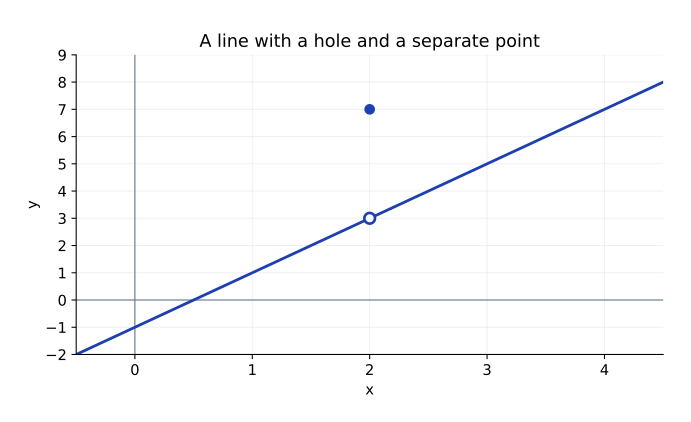
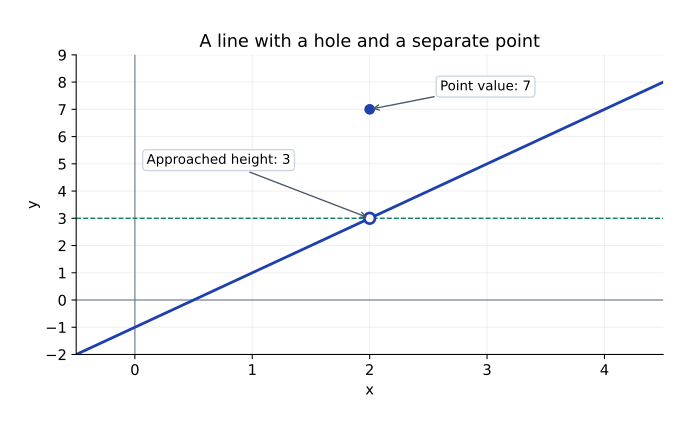
2. Use the graph of f below. It follows y=2x−1, with an open circle at (2,3) and a filled dot at (2,7). Find x→2−limf(x), x→2+limf(x), x→2limf(x), and f(2).
Trace the line toward x = 2 from both directions.Show worked solution
Tracing the line toward x=2 from either side gives x→2−limf(x)=x→2+limf(x)=3. Therefore x→2limf(x)=3. The filled dot gives f(2)=7; its height does not change the limit.
Both sides approach height 3; the filled point gives f(2) = 7.
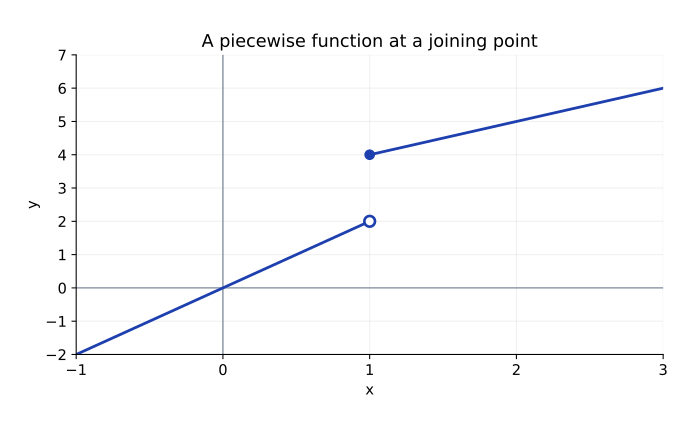
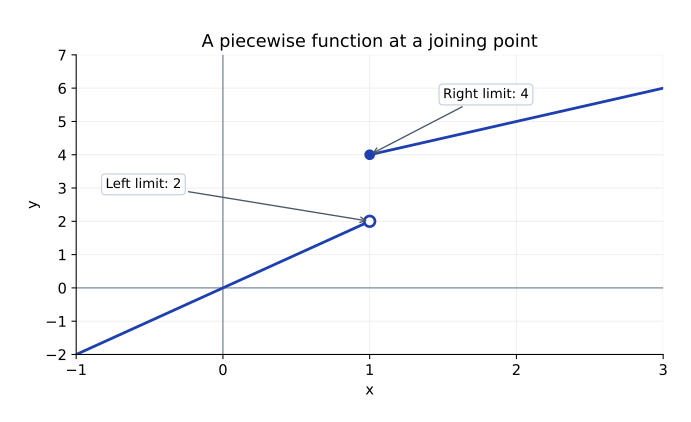
3. Let p(x)=2x for x<1 and p(x)=x+3 for x≥1. Use the graph and the formulas to find both one-sided limits at 1. Does x→1limp(x) exist?
Open and filled endpoints identify which branch includes the join.Show worked solution
The left branch approaches 2, while the right branch approaches 4. Thus x→1−limp(x)=2 and x→1+limp(x)=4. Since these differ, the two-sided limit does not exist, even though p(1)=4.
The left and right approached heights differ, so there is no two-sided limit.
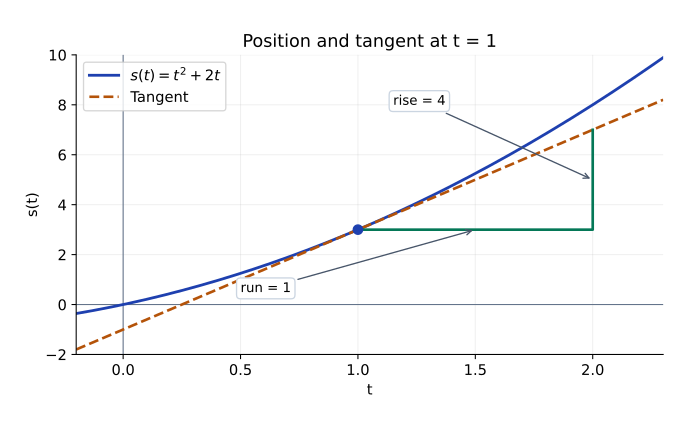
4. For s(t)=t2+2t, the average velocity on [1,1+h] is hs(1+h)−s(1)=4+h for h=0. Evaluate it for h=0.1,0.01,−0.01. Find the instantaneous velocity s′(1).
Show worked solution
The averages are 4.1,4.01,3.99. The derivative is the limit of these average rates: s′(1)=h→0limhs(1+h)−s(1)=h→0lim(4+h)=4. The tangent line at (1,3) has slope 4, in distance units per time unit.
The tangent has rise 4 over run 1, matching the derivative s prime of 1 = 4.